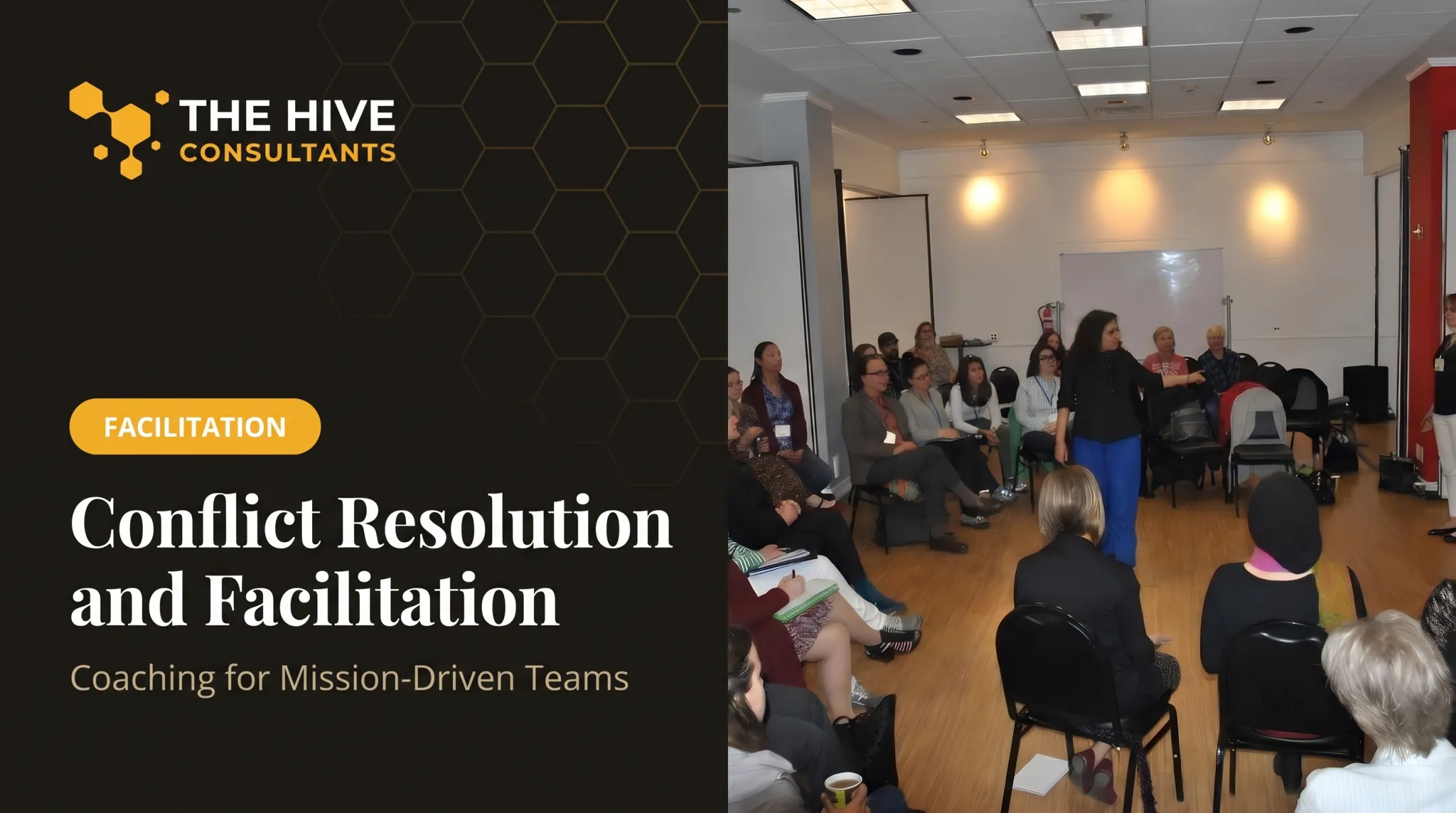

Facilitative leadership sits between the two. It is a way of leading that creates the conditions for shared thinking and ownership. Facilitation is the process and skill set that helps groups work productively.
This article covers definitions, how facilitators and leaders differ, core skills, practical application, inclusion, accountability, and the situations where a more directive approach fits better.
Key Takeaways
- Facilitative leaders focus on clarity, participation, and shared responsibility rather than having every answer.
- Group process is the facilitator’s job; direction and outcomes stay with the leader.
- Strong facilitation rests on listening, questioning, inclusion, conflict navigation, and follow-through.
- The approach pays off most on complex, cross-functional problems that need commitment to implementation.
What Is Facilitative Leadership?
What facilitative leadership means
Facilitative leadership is an approach in which a person with authority or influence makes it easier for a group to think, decide, learn, and act together. Michigan State University Extension describes it as sharing information and power, listening actively, and making decisions together.
The central shift is from prescribing to asking. The leader frames useful questions, listens, and draws out the expertise others hold. The Hive Consultants describes collaborative-era leadership as "less about command and more about connection."
How it works in practice
People support what they help shape. Lines and colleagues studied a major strategic change at a national telecommunications firm. They found employee participation was positively associated with change-goal achievement and commitment, and negatively associated with resistance. Results varied with how well the change fit the culture and employees' goals.
Facilitative leadership is not passivity. It does not mean dodging decisions or letting discussions run forever.
Picture a city transit agency redesigning its rider-complaint process. Operations, customer service, and IT each own a piece. The director states the problem, says the group will recommend and she will decide, and sets a six-week timeline. Each team brings its data, and the final decision arrives with a clear rationale.
Principles that define the approach
- Shared purpose that everyone can state
- Active listening and inclusive contribution
- Psychological safety, so people can take interpersonal risks
- Transparent decision-making and mutual accountability
- Learning from the process as well as the outcome
Those principles only hold when decision rights are explicit. Define the group's role deliberately: is it advising, co-creating, recommending, or deciding? The Hive's decision-rights guidance separates outcome ownership, decision authority, input timing, and when action is expected. Without that, groups drift into endless consultation or duplicated effort.

Facilitation vs. Leadership: Roles, Differences, and Connection
What a leader does and what a facilitator does
The International Association of Facilitators says the facilitator designs and guides the process while the group supplies ideas and content.
| Dimension | Leader | Facilitator |
|---|---|---|
| Purpose | Set direction, deliver results | Help the group work well together |
| Content | Often holds expertise | Stays neutral on content |
| Decision rights | May make the final call | Typically none |
| Accountability | Outcomes | Quality of process |

Telling, asking, and overlap
The practical difference is telling versus asking. That doesn't mean good leaders never give direction. They choose.
A leader can facilitate their own team, though internal facilitators carry a dual role. UMN Extension notes they may hesitate to raise difficult questions because of their position. An external facilitator can take that burden without taking over authority.
Leaders still use facilitation in common settings:
- Strategic planning
- Change initiatives
- Conflict resolution
- Team development
- Stakeholder engagement
In practice, a leader might frame the problem, set boundaries, invite dissent, and synthesize input, then announce the decision and the reasoning behind it.
Not consensus at any cost
Chasing unanimity can slow action and mute real differences. A University of Florida guide notes consensus may be a poor fit when a quick decision matters more than broad support.
A facilitative leader welcomes disagreement while still setting deadlines, decision rules, owners, and follow-up. Disagreement is input. It is not a veto unless the group's role says so.
When a more directive approach is necessary
Some moments need a fast, clear decision: safety threats, legal or ethical issues, and crises. Goleman's HBR article points to crisis and turnaround situations as times when a directive style can work. FEMA's Incident Command System, built on unity of command, is another example.
Treat facilitative leadership as a flexible capability. Pair it with directing, coaching, and delegating as the situation demands.
Essential Facilitation Skills and the Facilitator's Role
Active listening and observation
Facilitators listen for stated views, underlying concerns, power dynamics, missing perspectives, and common ground, not for their next comment. Useful techniques:
- Paraphrase and summarize
- Check assumptions out loud
- Watch who speaks, who doesn't, and who interrupts
- Name themes without judging them
Purposeful questioning
Open, neutral questions help groups define the problem, test assumptions, generate options, and prioritize. Minnesota Management and Budget's facilitation guidance recommends open-ended, non-leading questions about facts, reactions, meaning, and next steps.
Compare "What options haven't we considered?" with "Don't you think option B is best?" The first expands thinking. The second steers.
Inclusive participation and psychological safety
Edmondson's study of 51 manufacturing teams linked psychological safety to team learning behavior, which in turn related to performance. Safety is built through design:
- Structured rounds so everyone speaks
- 1-2-4-All: silent reflection, pairs, groups of four, then whole group
- Anonymous input for sensitive topics
- Clear participation norms and accessible materials
- Direct handling of interruptions and dominance
Conflict navigation
Surface disagreement early. Separate people from the problem, and move from stated positions to underlying interests. Harvard's Program on Negotiation calls this principled negotiation.
Know the difference between healthy challenge and interpersonal conflict. A meta-analysis by De Dreu and Weingart found relationship conflict strongly harmed team performance and satisfaction. Debate over ideas helps; personal attacks need boundaries or added support.

Decision capture and accountability
Before closing, summarize agreements, open questions, decision owners, next steps, deadlines, and how progress will be reviewed. This also builds leadership. Participants practice judgment, influence, and accountability during real work, not just in a classroom.
Applying Facilitative Leadership at Work
Prepare for clarity and inclusion
Before the meeting, settle on:
- Purpose and desired outcome
- Who decides, and who advises
- Participants and pre-work
- Accessibility needs
- Success criteria
Then ask the key question: is the group gathering information, generating options, solving a problem, recommending, or deciding? Say so up front.
Facilitate the conversation
- Open with purpose, decision rights, and norms
- Invite varied perspectives
- Organize ideas into themes
- Test assumptions and slow down when needed
- Manage time visibly
- Check understanding
- Move to a decision or next step
For remote and hybrid sessions, use deliberate turn-taking, visible notes, chat input, and shorter segments. The University of Wisconsin-Madison checklist suggests inviting remote participants first and naming people when asking for feedback. Microsoft's 2022 Work Trend Index found that 43% of remote employees did not feel included in meetings.

Convert participation into action
Close with a written record of decisions, owners, deadlines, risks, communication responsibilities, and follow-up points. Without it, good conversation evaporates.
For public-sector, nonprofit, and mission-driven organizations, The Hive Consultants supports leadership development and facilitated conversations through an integrated mix of facilitation, coaching, training, and applied learning, scoped with timeline and budget agreed upfront.
Conclusion: Lead by Creating the Conditions for Better Decisions
Facilitative leadership doesn't remove authority. It uses authority more deliberately, building clarity, trust, and ownership around hard work.
Before your next meeting or decision, ask three questions:
- What does the group need to contribute?
- What must I decide?
- What process will let both happen well?
Frequently Asked Questions
What does facilitative leadership mean?
It means guiding people toward shared understanding, decisions, and action by creating conditions for meaningful participation and accountability.
What are facilitation skills?
Core skills include active listening, purposeful questioning, inclusive participation, conflict navigation, synthesis, decision capture, and follow-through.
What is the role of a facilitator?
A facilitator prepares the process, structures participation, keeps the group aligned during the session, and documents next steps afterward.
What is the difference between a facilitator and a leader?
Leaders hold direction and accountability for outcomes. Facilitators primarily guide group process. One person can do both.
What are the 5 key leadership skills?
For facilitative leadership: listening, questioning, inclusive communication, conflict navigation, and accountability.
What is a leadership development role?
It builds leaders' capability through coaching, feedback, stretch assignments, reflection, and chances to practice facilitative leadership. CCL's 70-20-10 model puts most learning in challenging assignments.